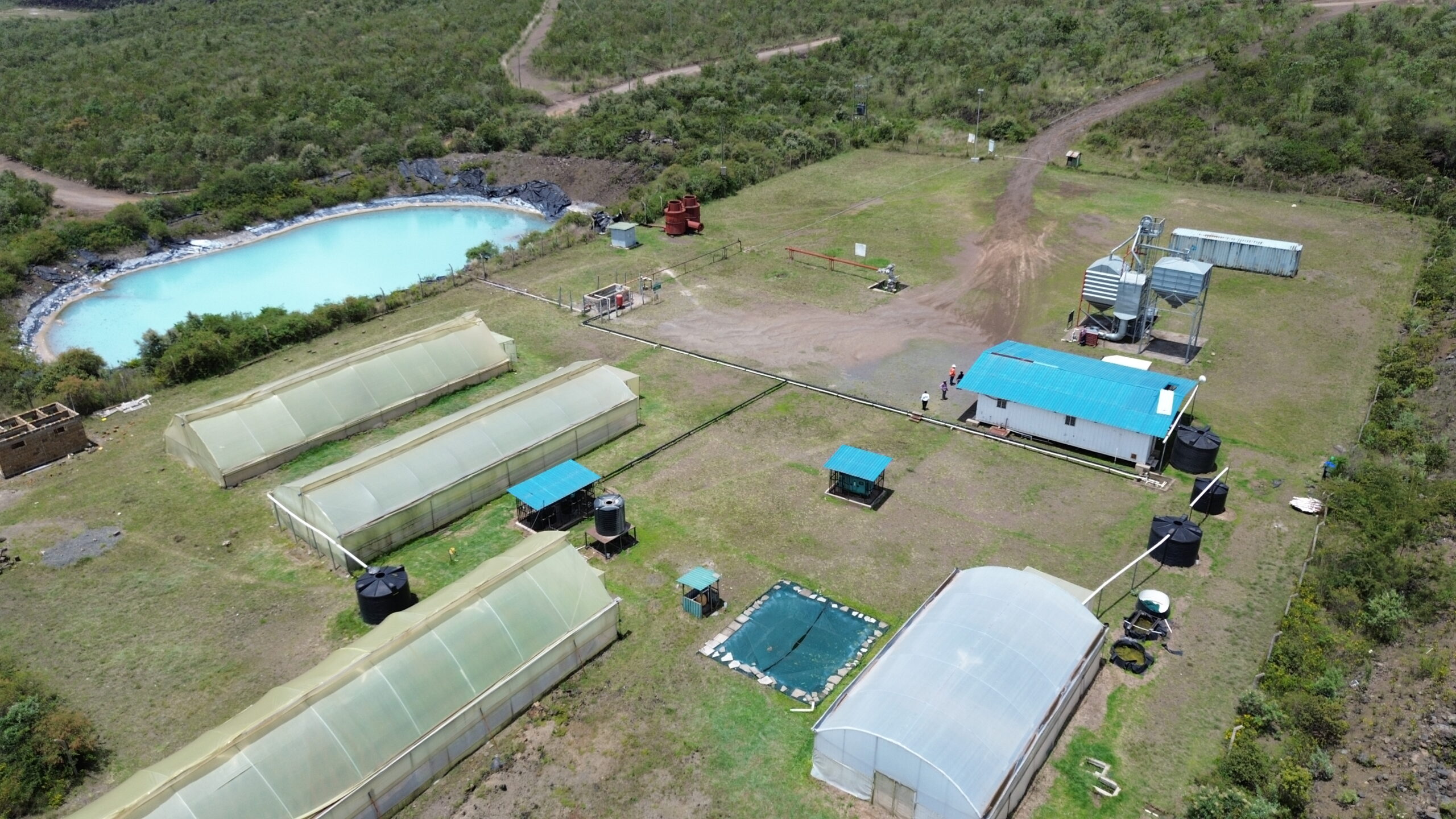
The state-owned Geothermal Development Company (GDC) has expanded direct-use projects across agriculture, industry and tourism — including milk pasteurization, aquaculture and greenhouse heating. From the national grid to the furrowed field, this subterranean heat is weaving itself into the fabric of the Kenyan economy.
Kenya’s geothermal journey dates back to the 1950s. The commissioning of the Olkaria I plant in 1981 made it the first African country to generate electricity from geothermal energy.
For decades, however, progress was slow, constrained by a technological monopoly held by Western and Japanese firms over core equipment. At its nadir, the GDC went more than a decade without commissioning a single new power station.That dynamic has shifted.
Chinese companies have cracked the monopoly open, offering more cost-effective solutions. Leading the push is Kaishan Group, a private company from Quzhou in Zhejiang Province — though its entry was not easy.”Initially, the Kenyan government was sceptical of us,” chairman Cao Kejian has recalled.
“So I personally funded the construction of the first plant — over 53 million U.S. dollars out of my own pocket.” The gamble paid off. Serving as EPC contractor, Kaishan built the Sosian Menengai plant — the first privately operated geothermal facility at the Menengai field — which began operations in August 2023 after passing rigorous third-party assessments.
With its credentials established, Kaishan moved from contractor to owner. In late 2023, it acquired OrPower 22, an independent power producer at Menengai, and immediately launched construction of a new plant.
Completed in just 14 months, the facility began commercial operations in March 2026, becoming Africa’s first geothermal project fully invested in, built and operated by a Chinese enterprise. It is now regarded as the best-performing geothermal plant currently operating in Kenya.
The ambition does not stop at electricity. At Olkaria, Kaishan is developing the world’s first integrated geothermal-to-hydrogen-and-ammonia project.
A 165.4 MW plant will generate electricity to produce green hydrogen through electrolysis; that hydrogen is then combined with atmospheric nitrogen and naturally occurring carbon dioxide from the geothermal wells to manufacture green ammonia and fertilizer — with raw materials drawn almost entirely from local sources.
The project is expected to produce 180,000 tonnes of urea and 300,000 tonnes of calcium ammonium nitrate annually, plugging a gaping hole in Kenya’s domestic fertilizer production and easing the burden on local farmers.
At the groundbreaking ceremony, President Ruto called the investment “efficient, reliable and sustainable,” adding that it would bolster food security and “save Kenya vast sums of hard currency previously spent on importing fertilizer — marking a significant stride toward climate-resilient green industrialization.”Kaishan’s general manager Dr. Tang Yan set out a broader vision.
“We hope to work hand-in-hand with Kenya’s energy sector,” he said, adding that “leveraging Kaishan’s modular geothermal technology and Kenya’s extraordinary resources to build a green energy ecosystem covering clean power, green hydrogen, green ammonia and green methanol — and together lead Africa toward a greener and more sustainable future.”
President Ruto has made “green industrialization” a central pillar of his agenda. At his inauguration, he told Kenyans the country was “on a transition to clean energy that will support jobs, local economies and sustainable industrialization,” and called on fellow African leaders: “Africa can lead the world. We have immense potential for renewable energy.”
Kenya aims not only to meet its own energy needs, but to demonstrate that developing countries can achieve rapid growth while honoring their climate commitments. In that effort, China has emerged as a decisive partner.
At the Forum on China-Africa Cooperation Beijing Summit, China announced 10 partnership actions for jointly advancing modernization, including a Green Development Partnership committed to implementing clean energy projects across Africa. In Kenya, that commitment is visible across the map.
China Gezhouba Group’s Thwake Dam will bring water security, irrigation and hydropower to over 1.3 million people in Kenya’s historically water-scarce lower eastern region.
In Garissa County, a Chinese-built 50 MW solar farm — East Africa’s largest photovoltaic facility — supplies clean power to communities long cut off from the national grid. In Nairobi, Chinese firms are contributing to the Dandora waste-to-energy project, converting a longstanding waste management burden into a model of circular economy.
The grid itself has been transformed. China Energy Engineering Group built the Kenya-Tanzania 400 kV interconnector, while China State Grid helped construct East Africa’s first high-voltage direct current line, bringing Ethiopian hydropower into the Kenyan network.
Together, they have turned an isolated national grid into a regional system.”As a global leader in this space,” President Ruto has said, “Kenya continues to demonstrate how every nation can achieve sustained, rapid and transformative growth while remaining true to climate action commitments.”
Deep in the Rift Valley, steam continues to rise ceaselessly from the earth’s interior. Turbines hum quietly among the acacia trees, converting this subterranean energy into light for millions — and soon, into nutrients for the nation’s fields.
In a turbulent world hungry for certainty in energy, Kenya’s offers a compelling answer: the green transition can begin from the ground beneath.
By Frederick Azelwa.